AI Payroll Software: How Tax Engines Power AI-Driven Payroll
AI handles the workflow. The tax engine handles the math. What payroll platforms need to know about building AI features on compliant tax infrastructure.


AI payroll software is no longer an emerging category. It's the expectation. The global payroll solutions market is valued at $32.6 billion in 2025 and projected to reach $51.4 billion by 2030, with AI and cloud infrastructure driving the majority of that growth. According to a Gartner survey of HR leaders, 82% plan to use some form of agentic AI within their HR functions by mid-2026. Gartner predicts that by 2030, half of all current HR activities will be either AI-automated or performed by AI agents. The adoption is accelerating. AI is already adding real value to payroll workflows. But as it takes on more of the process, one part demands a fundamentally different approach.
Where AI Adds Value in Payroll
AI is adding genuine value to payroll workflows in several areas:
Anomaly detection. Machine learning models trained on historical payroll data can identify unusual patterns: a pay run that's 40% higher than the prior period, a new deduction that doesn't match the employee's profile, or a time entry that conflicts with the schedule. These aren't rule-based checks; they're statistical models that learn what "normal" looks like for each employer and flag deviations before they reach the tax calculation step.
Natural language interfaces. Instead of navigating a dashboard to find an employee's net pay, a manager can ask "What's Sarah's take-home pay this period?" and get an instant answer. Chat-based payroll interfaces, where employers type commands like "Give Jen a raise" and the system executes the workflow, are becoming standard. The AI handles the conversation; the tax engine handles the calculation.
Compliance monitoring. AI can scan regulatory feeds and flag changes that affect a specific employer's payroll. When a city passes a new minimum wage ordinance or a state changes its SUI rate, AI can identify which employees are affected, quantify the impact, and surface the change to the compliance team before the effective date.
Onboarding automation. AI-powered onboarding can determine which tax withholding forms an employee needs based on their work and home addresses, pre-fill known data, and guide the employee through completion. When combined with I-9 verification and jurisdiction determination, this creates a hire-to-first-paycheck workflow that's largely autonomous.
In each case, the AI payroll agent handles the workflow. The tax engine handles the payroll calculations.
Why Payroll Tax Calculations Require a Deterministic Engine
Tax calculations are a deterministic, high-throughput activity that require a purpose-built tool. AI agents and other automation should call these tools with confidence to ensure compliance, not attempt the math themselves. To see why, consider the payroll taxes for an employee living at 415 South Main Street in Greensburg, Pennsylvania, where a single paycheck requires:
- Federal income tax withholding based on the employee's W-4
- Pennsylvania's 3.07% flat state income tax
- Hempfield Area School District earned income tax
- Greensburg City municipal earned income tax
- Local Services Tax withheld by the work-location municipality
- A comparison of the resident EIT rate against the non-resident work-location rate, withholding the higher of the two, as required by Pennsylvania Act 32
Pennsylvania alone has over 2,500 municipalities and nearly 500 school districts that levy local taxes. Zip codes routinely cross these boundaries. Only a payroll tax engine that resolves physical addresses to the correct PSD codes and applies current rules across overlapping jurisdictions can get this right.
Payroll tax is a deterministic problem. For a given set of inputs, there is exactly one correct answer, defined by federal, state, and local tax codes across 7,000+ jurisdictions. An LLM trained on last year's data doesn't know that a municipality raised its EIT rate effective April 1 or that a school district merged and its PSD code changed. The model will produce a number that looks plausible and is confidently wrong.
A $2 withholding error on one paycheck, multiplied across 10,000 employees and 26 pay periods, creates $520,000 in compliance exposure. Incorrect local tax withholding triggers W-2C reissues, employee complaints, and penalty notices. For payroll platforms, accuracy isn't a feature. It's the entire product promise.
How AI Payroll Platforms Use Tax Engines
The integration pattern between AI and tax engines is straightforward:
- The AI layer receives a request (from a user, a scheduled job, or another system)
- The AI layer structures the request into the parameters the tax engine needs (employee address, salary, pay frequency, filing status, deductions)
- The AI layer calls the tax engine API
- The tax engine returns precise withholding amounts across all applicable jurisdictions
- The AI layer presents the result to the user, logs it for audit, and triggers downstream workflows
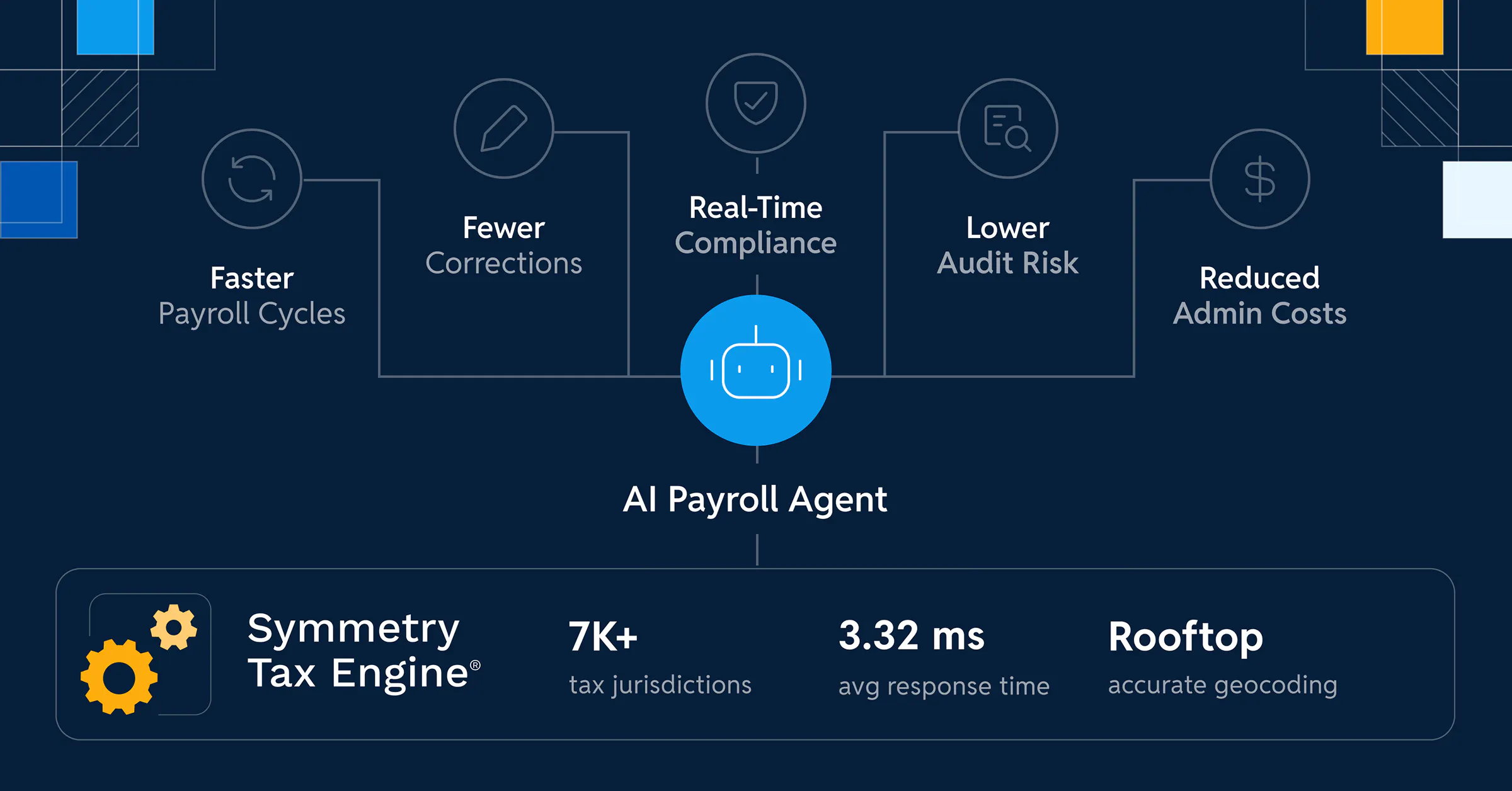
The Symmetry Tax Engine processes this calculation in an average of 3.32 milliseconds, fast enough for real-time AI interactions. When agentic payroll needs an answer before the user finishes reading the question, latency matters. A tax engine that takes 500ms or requires batch processing breaks the conversational experience.
What AI Payroll Delivers for Platform Clients
The combination of AI workflows and a deterministic tax engine produces measurable outcomes for the payroll platforms and the employers they serve. Platforms that have deployed AI-powered payroll with accurate tax infrastructure underneath are seeing results across five areas:
Significantly faster payroll cycles. AI-driven validation, automated exception handling, and real-time tax calculation compress the end-to-end payroll cycle. When the tax engine returns the right answer on the first call, in 3.32 milliseconds, there's no back-and-forth, no manual review of local tax edge cases, no reprocessing. Fewer corrections per pay run means faster close, every cycle.
Automated compliance monitoring. Tax rules change constantly across 13,000+ jurisdictions. AI agents paired with a continuously updated tax engine can adapt to law changes in real time: new minimum wage rates, updated SUI thresholds, revised local ordinances, all without manual intervention. The platform stays compliant; the employer never has to think about it.
Lower administrative costs. By automating tax research, jurisdiction determination, form selection, and calculation, AI payroll platforms reduce the administrative overhead that traditionally required dedicated payroll staff. Platforms building on proven tax infrastructure see faster payback on their compliance technology investment. Their clients see the savings in reduced support tickets and fewer compliance exceptions.
Reduced penalty and audit risk. Accurate geocoded jurisdiction determination eliminates the most common source of payroll tax errors: applying the wrong local tax rate because a zip code crossed a jurisdictional boundary. When every calculation is deterministic, traceable, and backed by Tax Logic explanations that document exactly how each withholding amount was derived, audit preparation goes from a weeks-long scramble to a straightforward export.
Payroll teams shift from processing to strategy. When AI handles routine calculations and the tax engine guarantees accuracy, payroll professionals spend less time on data entry and error correction, and more time on strategic advisory work. For platform clients, this means their payroll teams become compliance advisors rather than data processors.
These outcomes compound. Faster cycles mean fewer late corrections. Automated compliance means fewer penalties. Lower admin costs mean more budget for product innovation. And when the tax engine underneath is right every time, the AI layer on top can actually deliver on the promise of autonomous payroll.
What to Look for in a Tax Engine for AI Payroll
If you're building AI payroll capabilities or evaluating AI payroll software, the tax engine underneath is the most important technical decision. Here's what to evaluate:
Jurisdiction coverage. How many local jurisdictions does the engine cover? The U.S. has more than 7,000 local taxing authorities. If the engine only handles federal and state, you'll miss city taxes, county taxes, school district taxes, transit district levies, and other local obligations.
Address-level precision. Does the engine resolve tax jurisdictions from a physical address using geocoding, or does it rely on zip codes? Zip codes cross jurisdictional boundaries. Rooftop-level geocoding is the only reliable method.
Update frequency. Tax rules change constantly. How quickly does the engine incorporate new rates, new jurisdictions, and new rules? Does it update before or after the effective date?
API latency. For real-time AI interactions, the tax engine needs sub-10ms response times. Batch-oriented engines designed for overnight payroll runs won't work for conversational AI.
Explainability. Can the engine explain how it arrived at a result? Symmetry Tax Logic provides step-by-step, plain-language explanations of every calculation, citing the specific jurisdiction rules and rates applied. For AI payroll platforms, this explainability layer turns a number into a trusted, auditable answer.
Multi-state support. Does the engine handle reciprocity agreements, nonresident withholding, and allocation methods? For remote and distributed workforces, multi-state compliance is not optional.
Symmetry: The Tax Engine Powering AI Payroll Platforms
Symmetry powers payroll tax calculations for over 64 million employees. Our API-first architecture is built for the integration patterns AI payroll platforms need: real-time queries, structured responses, and sub-4ms latency across 7,000+ U.S. and Canadian jurisdictions.
Whether you're adding AI features to an existing payroll platform or building a new one from scratch, the Symmetry Tax Engine provides the compliance infrastructure your agentic payroll needs for correct answers.
What is AI payroll software?
AI payroll software uses artificial intelligence to automate payroll workflows like anomaly detection, employee onboarding, compliance monitoring, and natural language queries. For tax calculations, AI payroll platforms rely on a deterministic payroll tax engine to return accurate withholding amounts across federal, state, and local jurisdictions.
Can AI calculate payroll taxes?
No. Payroll tax calculation is a deterministic problem with exactly one correct answer for each combination of employee address, filing status, salary, and pay frequency. Large language models generate probabilistic outputs based on training data, which means they can't account for mid-year rate changes, new local jurisdictions, or overlapping tax boundaries. Accurate payroll tax calculation requires a purpose-built tax engine.
How do AI payroll platforms use tax engines?
The AI layer handles the user experience: receiving requests, structuring inputs, and presenting results. When a tax calculation is needed, the AI calls a tax engine API that resolves the employee's address to the correct jurisdictions, applies current tax rules, and returns precise withholding amounts. The Symmetry Tax Engine processes these calculations in an average of 3.32 milliseconds.
Why is local tax compliance so complex for AI payroll?
The U.S. has more than 7,000 local taxing authorities. A single address in Pennsylvania can trigger six overlapping tax obligations: federal, state, school district, municipal, Local Services Tax, and a required comparison of resident versus non-resident earned income tax rates. Zip codes cross jurisdictional boundaries, so accurate compliance requires rooftop-level geocoding to resolve each address to its correct PSD code and tax districts.
What should I look for in a tax engine for AI payroll?
The key criteria are jurisdiction coverage (7,000+ local authorities, not just federal and state), address-level geocoding (not zip code lookup), sub-10ms API latency for real-time AI interactions, continuous update frequency as tax rules change, explainability so each calculation is auditable, and multi-state support for reciprocity agreements and nonresident withholding.
What outcomes does AI payroll deliver for platform clients?
Platforms combining AI workflows with a deterministic tax engine report faster payroll cycles, fewer corrections per pay run, automated compliance monitoring across all jurisdictions, reduced audit preparation time, and lower administrative costs. When the tax engine is accurate on every calculation, the AI layer can deliver on the promise of autonomous payroll.