Agentic Payroll: Why AI Agents Need a Payroll Tax Engine
Agentic payroll is transforming how platforms process pay runs, but payroll AI agents need a deterministic payroll tax engine for compliant withholding. Learn the Agent + Engine + Explainability architecture.


Agentic payroll is here. Autonomous AI agents that execute multi-step payroll tasks without human intervention are moving from pilot to production across the industry. According to Gartner, 40% of enterprise applications will embed task-specific AI agents by the end of 2026, up from less than 5% in 2025. In payroll, that shift is already underway. Major payroll platforms are launching agent marketplaces and shipping autonomous payroll workflows for compliance verification, document generation, and pay run processing.
The premise is straightforward. Instead of a payroll administrator manually reviewing every pay run, an AI agent handles the routine work: validating time entries, checking compliance, running calculations, generating reports. It escalates only the exceptions that require human judgment. Gartner predicts that at least 15% of day-to-day work decisions will be made autonomously by agentic AI by 2028, up from 0% in 2024.
But every product team building agentic payroll has to answer one foundational question: where does the AI-powered payroll agent get its tax calculations?
What Makes Payroll Tax Different from Other Agentic Use Cases
In most agentic AI applications, the agent can tolerate approximation. If a support agent misinterprets a question, the customer asks again. If a scheduling agent picks a suboptimal time, the meeting still happens.
Payroll tax compliance doesn't work this way. Every calculation must be exactly right, every time, for every employee, across every jurisdiction. A federal withholding amount that's off by a few dollars per paycheck across thousands of employees compounds into significant compliance exposure. A missed local tax, a city transit levy or school district earned income tax the agent didn't know about, triggers notices, penalties, and reissued W-2s.
This is why Gartner's own research warns that over 40% of agentic AI projects will be canceled by 2027 due to escalating costs, unclear value, or inadequate risk controls. In payroll, the risk control is the payroll tax engine. Tax calculations are a deterministic, high-throughput activity that requires a purpose-built payroll tax infrastructure. Agents should call a payroll tax engine with confidence to ensure compliance, not attempt the calculations themselves.
Payroll Architecture: AI Agent, Powered by Payroll Tax Engine and Explainability
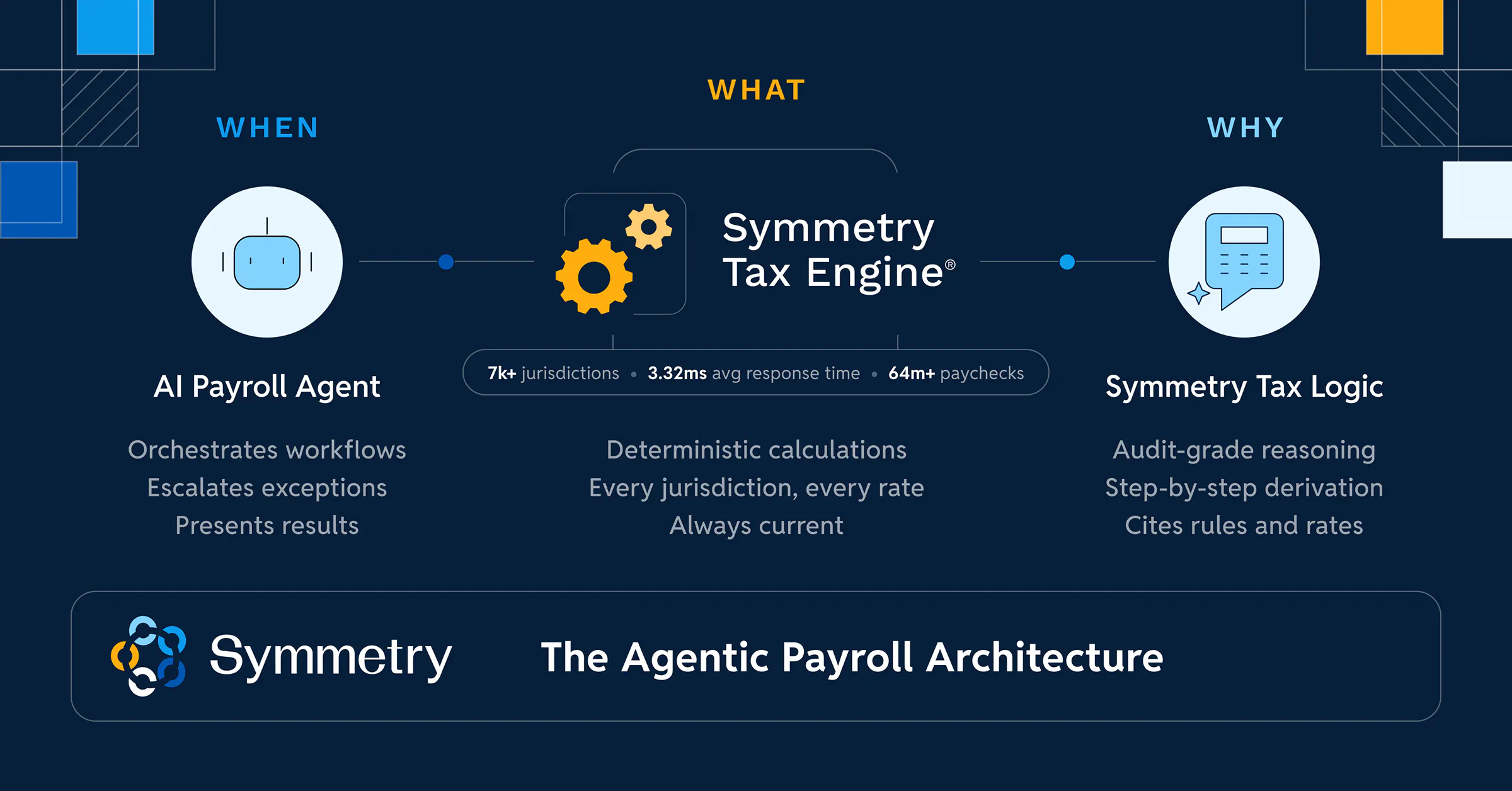
The agentic payroll systems that will succeed in creating client outcomes share a three-layer technology architecture. This is what separates agentic payroll from the experiments that get canceled.
The AI agent layer manages workflow orchestration. It receives triggers (a new hire, a pay run, a rate change), determines what actions to take, and coordinates between systems. The agent might use an LLM for natural language understanding, a rules engine for business logic, and a tool calling for external API integration. This is where frameworks like LangChain, CrewAI, and AutoGen operate.
The payroll tax engine layer provides deterministic compliance calculations. When the agent needs to calculate withholding, it calls the payroll tax engine with structured inputs (employee address, salary, filing status, pay frequency, deductions) and receives structured outputs (federal withholding, state withholding, local withholding, FICA, employer taxes). The Symmetry Tax Engine returns these results in an average of 3.32 milliseconds across 7,000+ U.S. jurisdictions, fast enough for the agent to call mid-workflow without introducing latency.
The tax explainability layer provides audit-grade explanations of complex payroll tax calculations. When a client asks "why is my withholding different this month?", the agent can't just return a number. It needs to explain which jurisdiction rules changed, how the calculation was derived, and what inputs affected the result. Symmetry Tax Logic provides this layer: step-by-step, plain-language explanations of every tax calculation, citing specific rates and rules. This turns the payroll agent's answer from a number into a trusted explanation for your clients, and boosting your team expertise.
This three-layer separation is what makes agentic payroll reliable:
- When — the AI agent orchestrates when to calculate, which employees to include, and whether to escalate
- What — the payroll tax engine decides what the correct withholding is across every applicable jurisdiction
- Why — the explainability layer documents why each number is what it is, citing the specific rules and rates applied
What the Payroll AI Agent Handles vs. What the Payroll Tax Engine Handles
The division of payroll responsibility is clear:
The payroll AI agent orchestrates: When to run payroll. Which employees to include. What deductions to apply. Whether to escalate an exception. How to present results to the user. What natural language explanation to provide.
The payroll tax engine decides: What the correct withholding is for each jurisdiction. Which local taxes apply based on the employee's geocoded work and home addresses. What the current FICA, FUTA, and SUI rates are. How multi-state reciprocity affects the calculation. What the minimum wage is at the employee's work location.
The tax explainability layer documents: Which jurisdiction rules changed and when they took effect. How the calculation was derived step by step. What inputs (address, filing status, salary, deductions) affected the result. Which rate applied and why it differs from the prior period. The structured trail that proves compliance to clients and boosts your teams’ tax expertise.
This is why the separation matters. The AI agent brings intelligence to the workflow. The payroll tax engine brings certainty to the calculation.
Building Payroll AI Agents with the Symmetry Tax Engine
For teams building agentic payroll, Symmetry provides the payroll tax engine and the developer tools to integrate it into any payroll compliance agent architecture.
REST APIs. The Symmetry Tax Engine accepts JSON requests and returns structured responses. Pass an employee's address, salary, filing status, and pay frequency. Get back precise withholding amounts across every applicable jurisdiction, federal, state, and local, in an average of 3.32 milliseconds. Full API documentation includes endpoint references, authentication guides, and interactive examples.
OpenAPI specification. Symmetry publishes a complete OpenAPI spec that agent frameworks can consume directly. This means teams building with function calling patterns for OpenAI, Anthropic, or other LLM providers can generate typed function schemas from the spec, giving the agent a structured interface to the payroll tax engine without any manual schema definition.
Tax Withholding Forms API. Beyond tax calculations, agentic payroll workflows often need to determine and complete withholding forms during onboarding. The Symmetry Payroll Forms API accepts home and work addresses, returns applicable tax withholding forms across federal, state, and local jurisdictions, and delivers completed PDFs with the correct tax parameters. Over 135 compliant forms for the U.S. and Canada.
Local Tax API. Agents need to resolve employee addresses to the correct tax jurisdictions before calling the payroll tax engine. Symmetry Payroll Point handles geocoded jurisdiction determination, resolving physical addresses to PSD codes, local tax districts, and school district boundaries, including the complex overlapping jurisdictions in states like Pennsylvania.
What Agentic Payroll Delivers for Platform Clients
Platforms that architect agentic payroll on a reliable payroll tax engine see results across five areas:
Faster payroll cycles. Agents that validate, calculate, and close pay runs autonomously compress cycle times. When the payroll tax engine returns correct results on the first call, there's no manual review loop for local tax edge cases.
Fewer corrections. Deterministic calculations eliminate the rounding errors, stale rates, and missed jurisdictions that generate W-2C reissues and employee complaints.
Automated compliance. Agents paired with a continuously updated payroll tax engine adapt to law changes, new minimum wage rates, revised local ordinances, and updated SUI thresholds, without manual intervention.
Reduced risk. Geocoded jurisdiction determination eliminates the most common source of local tax errors. Tax Logic explanations document how each withholding amount was derived from rules, making client responses straightforward.
Payroll teams shift to strategic work. When AI agents handle routine processing and the payroll tax engine guarantees accuracy, payroll professionals become higher value compliance advisors rather than data processors.
Symmetry: The Payroll Tax Engine AI Agents Call
Symmetry has been building payroll tax compliance infrastructure for over 40 years. The Symmetry Tax Engine powers paychecks for over 64 million employees annually across 7,400+ U.S. and Canadian jurisdictions, with sub-4ms response times built for the real-time, high-frequency calling patterns that agentic payroll demands.
Whether you're adding AI agent capabilities to an existing payroll platform or building a payroll platform from scratch, Symmetry provides the payroll tax engine your AI agents call for correct answers. The agent handles the workflow. Symmetry handles the payroll compliance. That's the AI payroll software architecture.
What is agentic payroll?
Agentic payroll refers to autonomous AI agents that execute multi-step payroll tasks without human intervention. These agents orchestrate workflows like validating time entries, running compliance checks, and presenting results, while calling a deterministic payroll tax engine for accurate withholding calculations across all applicable jurisdictions.
Why can't an AI agent calculate payroll taxes on its own?
Payroll tax calculation is a deterministic problem with exactly one correct answer per employee per pay period. AI agents built on large language models generate probabilistic outputs that might be unable to account for mid-year rate changes, new local jurisdictions, or overlapping tax boundaries like Pennsylvania's PSD code system. Agents need to call a deterministic payroll tax engine for accurate tax calculations.
What is the Agent + Payroll Tax Engine + Explainability architecture?
This is the three-layer tech architecture for reliable agentic payroll. The agent layer orchestrates workflows and user interactions. The payroll tax engine layer (like the Symmetry Tax Engine) provides deterministic, real-time compliance tax calculations. The explainability layer (like Symmetry Tax Logic) provides clear, plain-language explanations of every calculation.
How do AI agents integrate with Symmetry's payroll tax engine?
Symmetry provides REST APIs with full developer documentation, an OpenAPI specification that agent frameworks can consume for function calling schemas, a Payroll Forms API for onboarding workflows, and an I-9 API with embedded E-Verify. All return structured results in an average of 3.32 milliseconds.
What outcomes does agentic payroll deliver for platform clients?
Platforms architecting agentic payroll on a reliable payroll tax engine see faster payroll cycles, fewer corrections and W-2C reissues, automated compliance monitoring across all jurisdictions, reduced client support response time, and payroll teams that shift from processing to strategic advisory work.
How many jurisdictions does the Symmetry Tax Engine cover?
The Symmetry Tax Engine covers federal tax, all 50 U.S. states, and over 7,000 local taxing authorities including cities, counties, school districts, and transit districts. Symmetry also covers Canadian provinces and territories. Address-level geocoding resolves each employee's physical address to the correct overlapping jurisdictions.